
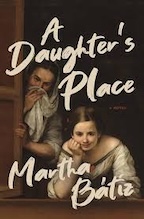
House of Anansi Press, Inc. To be published May 20, 2025.
Reviewed by Alma Ramos-McDermott
Category: Adult
Rating 5 stars
“Don Quixote,” published in 1605, was translated into many languages and became well-known around the world. Its author, Miguel de Cervantes, lived with his rich wife in Spain but, away from her, lived a life of semi-poverty. Unable to collect money on his masterpiece after its first printing, he was constantly in debt as he sought sponsors for what he wanted the public to see in his writings. “A daughter’s place” tells of de Cervantes’ struggles as he sought to keep his unsuspecting wife away from the life he led with his sisters, niece, and illegitimate daughter in another city.
Fifteen-year-old Isabel lived in poverty with her grandmother, sister, aunt, and cousins until she was told of her status and brought to her Aunt Magdalena’s home in 1599. There, though she looked exactly like Miguel, she was told to act as a maid to keep neighbors from being suspicious. At his request she was registered as Isabel de Saavedra, his nom de plume, because he didn’t want his wife to know of his infidelity. Magdalena was given legal guardianship and, though treated as family and schooled in reading, sewing, and deportment by both of her aunts and her cousin Constanza, Isabel felt as if she didn’t belong to anyone.
Through Isabel and Constanza’s alternating voices, the highs and lows of the de Cervantes household over the years are detailed along with difficulties females faced in a male-dominated world. Though each of the them were bound by societal ties, they found their voices to rebel in uniquely different ways. “A daughter’s place” is their story, as well as Miguel’s.
In my college freshman English comp. class, my fellow Hispanics and I cringed when our professor mispronounced the name “Don Quicksot.” Though we didn’t know anything about him, we recoiled at hearing what should have been pronounced “Keyhote.” “A daughter’s place” gives background information on how that famous knight came to be, as well as insight into the Spanish empire of Miguel de Cervantes’ time and place. Readers will gain historical knowledge of old Spain as well as insight into how women from his household bent rules to live the life they chose, rather than one chosen by men.
Recommended for Adults.
Note: This review was originally published on You Decide: Should I read it or not?
Reproduced here as a courtesy to Alma Ramos-McDermott

 REFORMA de Florida