
“Beasts of Carnaval” Rosália Rodrigo

Mira (Harlequin Enterprises) HarperCollins. To be published July 29, 2025.

Recommended for Adults.

Reviewed by: Alma Ramos-McDermott

Category: Adult

Rating: 5 stars

Sofía missed her twin brother Sol. Born slaves, they were sold away from their loving mother when they were 5 years old to the Hacienda Esperanza in Etérea owned by rich Hisperians. Over 300 years ago Hisperians conquered Etérea and its native people, the Taike’ri. Though Hisperians raped, sold, and murdered them by the hundreds of thousands in their lust for gold and riches the Taike’ri were almost decimated, but their descendants lived on as mestizos and slaves. Sol and Sofía knew some of their ancestral history, but most had been obscured through years of Hisperian dominance.

Many years passed while they labored under their bonds. Five years earlier Sol and his master left to attend el Carnaval de Bestias on a nearby island but never returned. Sofía spent years collecting every scrap of information on the Carnaval that she could find, seeking information on her brother. Though she had been freed at age 14 it took her many more years to gather the courage to leave Adelina, her young mistress and best friend, to go find her brother.

She thought she’d succeeded in slipping away, but Adelina found out and they went together. When they arrived on the island, it was unlike anything Sofía had ever experienced. Everything was beautiful. The hotel was detailed and opulent, and every desire was met. Hotel workers wore scary-looking masks, portraying themselves as vejigantes. Guests also wore masks, spending their days partying, drinking, carousing, and dancing. Everyone slept and rose at the same time, ate sumptuously decadent food, and were entertained with nightly carnival-like shows. Everything followed the same incredible pattern every day, so the girls soon forgot why they’d come to the island. They were having too much fun.

Things went on this way for a long time, until Sofía began to remember why they were there. Though she kept forgetting, she also began having strange dreams and felt like she was being watched. Adelina was oblivious, but Sofía was determined to find out why she kept forgetting and discover what was hiding under the Carnaval’s perfect surface. What she found out would shake the foundations of her life and cause her to question everything she’d ever known to be true.

As I read, my mind kept making comparisons between the Taíno and the Taike’ri. Descendants of the Taíno of Puerto Rico, like me, grew up thinking our ancestors were destroyed by Columbus and his fellow conquistadores/torturers. We are still here! There is much to learn about the Taíno, so I enjoy books like this which shed more light on their life before Columbus “discovered” them.

Recommended for Adults.

I received a digital advance reading copy of this book from the publisher in exchange for an honest review.

Note: This review was originally published on You Decide: Should I read it or not?

Reproduced here as a courtesy to Alma Ramos-McDermott.
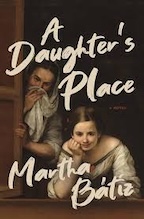
“A daughters place” Martha Bátiz

House of Anansi Press, Inc. To be published May 20, 2025.

Reviewed by Alma Ramos-McDermott

Category: Adult

Rating 5 stars

“Don Quixote,” published in 1605, was translated into many languages and became well-known around the world. Its author, Miguel de Cervantes, lived with his rich wife in Spain but, away from her, lived a life of semi-poverty. Unable to collect money on his masterpiece after its first printing, he was constantly in debt as he sought sponsors for what he wanted the public to see in his writings. “A daughter’s place” tells of de Cervantes’ struggles as he sought to keep his unsuspecting wife away from the life he led with his sisters, niece, and illegitimate daughter in another city.

Fifteen-year-old Isabel lived in poverty with her grandmother, sister, aunt, and cousins until she was told of her status and brought to her Aunt Magdalena’s home in 1599. There, though she looked exactly like Miguel, she was told to act as a maid to keep neighbors from being suspicious. At his request she was registered as Isabel de Saavedra, his nom de plume, because he didn’t want his wife to know of his infidelity. Magdalena was given legal guardianship and, though treated as family and schooled in reading, sewing, and deportment by both of her aunts and her cousin Constanza, Isabel felt as if she didn’t belong to anyone.

Through Isabel and Constanza’s alternating voices, the highs and lows of the de Cervantes household over the years are detailed along with difficulties females faced in a male-dominated world. Though each of the them were bound by societal ties, they found their voices to rebel in uniquely different ways. “A daughter’s place” is their story, as well as Miguel’s.

In my college freshman English comp. class, my fellow Hispanics and I cringed when our professor mispronounced the name “Don Quicksot.” Though we didn’t know anything about him, we recoiled at hearing what should have been pronounced “Keyhote.” “A daughter’s place” gives background information on how that famous knight came to be, as well as insight into the Spanish empire of Miguel de Cervantes’ time and place. Readers will gain historical knowledge of old Spain as well as insight into how women from his household bent rules to live the life they chose, rather than one chosen by men.

Recommended for Adults.

Note: This review was originally published on You Decide: Should I read it or not?

Reproduced here as a courtesy to Alma Ramos-McDermott

“My name is Emila del Valle” Isabel Allende Translated from the Spanish by Frances Riddle

Ballantine Books (Random House). To be published May 6, 2025.

Reviewed by Alma Ramos-McDermott

Category: Adult

Rating: 5 stars

Emilia was born in 1866 to a bitter woman who, when she was a novice nun, got pregnant. Unable to continue living with the other nuns, she married an older man who had worked with her when she was a novice and loved her. As Emilia grew, she was inundated with stories of her rich and cowardly father who refused to acknowledge his daughter and the inheritance she was owed from his rich coffers.

Emilia loved her stepfather, who taught her everything he knew and instilled in her that she could be anything she wanted to be. As a female she was expected to follow the pre-ordained path of marriage, or specific feminine vocations. However, Emilia had no desire to be a wife, nurse, or teacher. Her passion was writing so, under a male pseudonym, she began writing a series of successful dime store crime novels.

At age twenty-two Emilia became a crime reporter at The Daily Examiner in San Francisco, paired with a male reporter who took her under his wing. Eventually they travelled to Chile to report on its civil war, as Emilia convinced the editor to also let her go because her father was Chilean, and she spoke Spanish.

As Emilia learned more about Chile, its beauty, and its warring factions, she began feeling a love and connection to the country. However, separated from the man she loved, and finding herself on the wrong side of the winning army, Emilia soon found out Chile’s beauty didn’t extend to the black hearts of her countrymen.

In her own words, Emilia explains why she was not the typical female of her time and place. Her rich descriptions and life experiences will keep readers on the edges of their seats until its final, satisfying conclusion.

Highly recommended for Adults.

Note: This review was originally published in: You Decide: Should I read it or not?

Reproduced here as a courtesy to Alma Ramos-McDermott